
We may earn a commission when you buy through these links, at no extra cost to you. Prices and details change often: check the product and price on the retailer's page before you buy (accuracy). How we make money
On this page
Most Australian home gyms should start with METEOR Essential bumper plates: 450 mm across at every weight from 2.5 to 25 kg, colour-coded, and sold by an Australian supplier. If you lift in a rack and want quieter, grippable plates, METEOR's urethane or rubber-coated tri-grip plates suit better than bumpers.
Best weight plates in Australia
- Best overall
Natural rubber bumpers at the 450 mm IWF diameter with a steel centre ring, colour-coded from 2.5 to 25 kg, from an Australian supplier.
 Best urethane plates
Urethane grip plates with a polished steel trim ring and a 50 mm hole, in colour-coded pairs from 2.5 to 20 kg.
from$79.45 Best for racked lifting
Rubber-coated cast iron with three grip cut-outs and a steel trim ring, in pairs from 2.5 to 20 kg. Quieter to load than bare iron.
from$102.91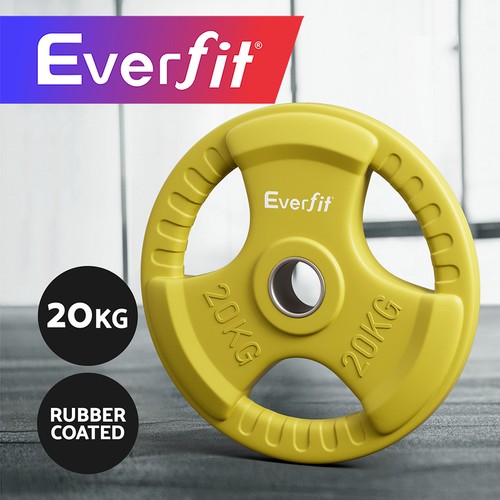 Best rubber-coated alternative
Rubber-coated cast iron tri-grip plates with a 50.6 mm hole on the 15 and 20 kg plates and a 1 year warranty, in 5, 15 and 20 kg.
from$82.95 Best for 1 inch bars
Thin cast iron plates with a 25.4 mm hole for standard bars and dumbbell handles, from 0.5 to 10 kg, with every plate's size published.
from$57.25
| Model | METEORMETEOR Essential Rubber Bumper Plates | METEORMETEOR Urethane Olympic Weightlifting Plates | METEORMETEOR Olympic Triple-Grip Rubber Weight Plates | EverfitEverfit Weight Plates, Rubber-Coated Cast Iron Tri-Grip, 5 to 20 kg (FIT-K-DB-PL) | METEORMETEOR Essential Standard Cast Iron Weight Plates (25.4 mm) |
|---|---|---|---|---|---|
| Best price | — | $79.45 | $102.91 | $82.95 | $57.25 |
| Check price | No listed price | ||||
| Material | Bumper (full natural rubber, steel centre ring) | Urethane, steel trim ring | Rubber coated cast iron, steel trim ring | Cast iron, rubber coated | Cast iron |
| Hole | 50 mm | 50 mm | 50 mm | 50.6 mm | 25.4 mm |
| Diameter | 450 mm | Not listed | Not listed | Not listed | Not listed |
| Min weight | 2.5 kg | 2.5 kg | 2.5 kg | 5 kg | 0.5 kg |
| Max weight | 25 kg | 20 kg | 20 kg | 20 kg | 10 kg |
How to choose weight plates
- Hole size: match your bar. Olympic plates have a hole of about 50 to 51 mm for 2 inch (50 mm) sleeves. Standard plates have a 1 inch (25.4 mm) hole, or a little more on some makes, for standard bars and spinlock dumbbell handles. Neither fits the other bar.
- Drop the bar? Buy bumpers. Bumper plates are solid rubber or urethane, made to be dropped on a suitable floor. Iron and steel plates are thinner and are made for racked lifts: squats, bench presses and presses where the bar goes back in the rack.
- Diameter: 450 mm for pulls. Full-size bumpers are 450 mm (17.7 in) across, the IWF size, so the bar starts at the same height whatever is loaded. Iron plates get smaller as they get lighter, so a light deadlift on iron starts lower.
- Width: thinner plates load more. Makers list a 25 kg bumper at about 86 to 100 mm wide and a 45 lb bumper at about 61 mm, while a 20 kg calibrated plate can be 21 mm. A typical Olympic bar has about 41 cm of loadable sleeve. The compare table has no width column, so each pick's section gives the widths its maker publishes.
- Accuracy: check the stated tolerance. Training bumpers that state one are within 1% of their weight, competition bumpers within about 0.1%, and calibrated plates within 10 g, per their makers. Most iron plate pages here state none. Tolerances are in each pick's section, not the table.
- Pairs or singles: check the pack. Some makers sell pairs and others single plates, so the price on a card can be for either.
- Material: rubber, urethane or coated iron. Urethane is slimmer and does not tear like rubber, per the makers, while rubber-coated iron is quieter to load than bare iron but is still not made for drops.
With a 20 kg (45 lb) bar, start with a pair of each plate you will use most, then add heavier pairs and small change plates as the weight goes up. Our barbell weight chart lists what each bar weighs, so you can count it into the total. Our plate calculator shows which plates go on each side for a target weight and plans the smallest plate set that reaches every weight you want to lift. Our home gym planner suggests kit for your space and budget.
Lift in a rack and want quiet plates: METEOR tri-grip rubber plates. Lift from the floor and drop the bar: METEOR Essential bumpers. Own a 1 inch bar or spinlock dumbbells: METEOR standard cast iron plates.
Bumper plate colours
Colour-coded bumpers show the weight at a glance. The usual scheme on the plates in this guide:
- Kilo plates: red 25 kg, blue 20 kg, yellow 15 kg, green 10 kg and white 5 kg, with grey for 2.5 kg on some makes.
- Pound plates often use grey 10 lb, green 25 lb, yellow 35 lb, blue 45 lb and red 55 lb.
- All-black plates carry the colour on a stripe, fleck or marking instead, or not at all, so you read the number.
Weight plates on a budget
If you never drop the bar, price iron as well as bumpers: where one maker sells both, its cast iron plates can list for less per kilo. Pairs or sets often work out lower per kilo than single plates. If you deadlift or clean, a few full-size bumpers plus iron plates for squats and presses is a common middle route. Buy only the plates you will load now: change plates and heavier pairs can come later.
In Australia, choose iron for racked lifts on a budget: METEOR's rubber-coated tri-grip plates or Everfit's rubber-coated cast iron plates, both sold by Australian sellers. If you drop the bar, METEOR's Essential bumpers are the 450 mm option, and buying the light plates in pairs and the heavy ones singly keeps the first order small.
METEOR Essential bumper plates: best overall
METEOR is the own brand of Gym Mart, a Melbourne supplier. The Essential bumpers are natural rubber at the 450 mm IWF diameter, with a steel centre ring for 50 mm bars, colour-coded grey 2.5, white 5, green 10, yellow 15, blue 20 and red 25 kg.
The 2.5, 5 and 10 kg plates come in pairs and the 15, 20 and 25 kg plates singly. METEOR says the 2.5 and 5 kg plates must not be dropped on their own.
Pros
- 450 mm at every weight, so the bar sits at standard height
- Steel centre ring
- Colour-coded with raised markings
Cons
- 2.5 and 5 kg plates must not be dropped alone, per METEOR
- Mixed pairs and singles, so check the pack
- No warranty term on the maker page
METEOR urethane plates: best urethane plates
These urethane plates have three grip slots, a machine-grooved polished steel trim ring and a 50 mm hole, in pairs of 2.5 kg (orange), 5 (red), 10 (green), 15 (yellow) and 20 kg (blue). METEOR says urethane is odourless and does not tear or crumble like rubber.
Diameter changes with weight, so treat them as grip plates for racked lifts rather than bumpers to drop.
Pros
- Odourless urethane that does not tear, per METEOR
- Grip slots on every plate
- Steel trim ring protects the sleeve
Cons
- Diameter varies by weight
- Heaviest plate 20 kg
- No warranty term on the maker page
METEOR tri-grip rubber plates: best for racked lifting
These are cast iron plates with a thick rubber coating, three grip cut-outs and a steel trim ring in the 50 mm hole, sold in pairs of 2.5, 5, 10, 15 and 20 kg. The coating makes them quieter to load and kinder to floors than bare iron.
They are not bumpers: the diameter varies with weight and they are not made for drops.
Pros
- Grip cut-outs for carrying and loading
- Rubber coating cuts noise
- Steel trim ring in the hole
Cons
- Not made for drops
- Heaviest plate 20 kg
- Pairs only
Everfit tri-grip plates: best rubber-coated alternative
Everfit's rubber-coated cast iron plates have a three-hole grip and come as 5 kg (black, 25 cm), 15 kg (red) and 20 kg (yellow) singles and pairs. The 15 and 20 kg plates have a 50.6 mm hole and are 4 cm thick, and Everfit gives a 1 year warranty.
There is no 10 kg plate or change plate in the range, so pair them with other plates for smaller steps.
Pros
- Three-hole grip
- 50.6 mm hole on the 15 and 20 kg plates
- 1 year warranty, per Everfit
Cons
- No 10 kg or change plates
- Rubber-coated iron, not a bumper
METEOR standard cast iron plates: best for 1 inch bars
These thin cast iron plates have a 25.4 mm hole for standard bars and dumbbell handles, in pairs or fours of 0.5, 1.25, 2.5, 5 and 10 kg. METEOR publishes the size of each: 100 mm across and 8 mm thick at 0.5 kg, up to 270 mm and 35 mm at 10 kg.
Pros
- Thin profile fits more on short dumbbell handles
- Every plate's size published
- Pairs or packs of four
Cons
- Will not fit 50 mm Olympic bars
- Heaviest plate 10 kg
- Bare iron, no rubber coating
Frequently asked questions
What are the best weight plates for a home gym?
If you deadlift, clean or might drop the bar, full-size rubber bumper plates are the most versatile buy, used on rubber flooring. If you only squat, bench and press inside a rack, cast iron or rubber-coated iron plates are thinner and have a lower list price per kilo. Many home gyms end up with a few bumpers plus iron plates for heavy racked lifts.
Are bumper plates worth it?
They are worth it if you lift from the floor, do Olympic lifts or may need to drop a bar, because they are made for drops and every full-size plate is the same height. They are the wrong buy if you only lift in a rack and want to load a lot of weight: bumpers are much thicker than iron, so the sleeve fills sooner. Some makers say their lightest bumpers must not be dropped on their own.
What do bumper plate colours mean?
On kilo plates the usual scheme is red 25 kg, blue 20 kg, yellow 15 kg, green 10 kg and white 5 kg, with grey for 2.5 kg on some makes. Pound plates often use grey 10, green 25, yellow 35, blue 45 and red 55 lb. All-black plates show the colour on a stripe, fleck or marking, or not at all.
Do standard weight plates fit an Olympic bar?
No. Standard plates have a 1 inch (25.4 mm) hole, or a little larger on some makes, and an Olympic bar has 2 inch (50 mm) sleeves. Olympic plates have a hole of about 50 to 51 mm and will slide around on a 1 inch bar. Buy plates that match your bar, and check the hole size in the compare table.
How many weight plates do I need?
Work back from the heaviest lift you expect to load soon. With a 20 kg (45 lb) bar, a pair of each common plate plus a pair of small change plates covers most targets, and you can add heavier pairs later. Our plate calculator shows the plates for each side of the bar for any target weight.
How we chose
We have not tested these plates. We compared each maker's published material, hole size, diameter, plate widths, weight tolerance, weight range and pack (pair or single), plus warranty where it is stated. We only included plates sold new from inside each country, by the maker's own local store or a retailer listing that ships from there. We did not rely on owner reviews for any claim. List prices, used only to rank on value, were checked between 11 and 15 November 2026.
Related tools
Get price drops on this kit by email
Prices change. We'll email you when one we compare drops, only when it's worth sending.
Sources
- Rogue Echo Bumper Plates V2: IWF 450 mm diameter, tolerance and plate widths
- METEOR Essential bumper plates: IWF diameter, colour codes and drop guidance
- Titan Fitness LB Economy Color bumper plates: pound colour coding
- Strength Shop Calibrated Plates: IPF tolerance and plate thickness
- Bells of Steel KG Competition Bumper Plates: tolerance and IWF status