
Everfit
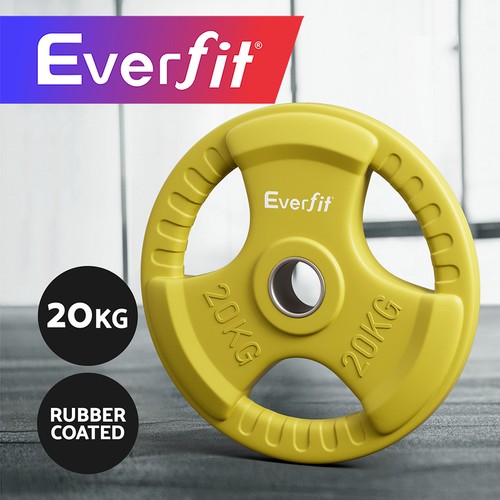
Everfit Weight Plates, Rubber-Coated Cast Iron Tri-Grip, 5 to 20 kg (FIT-K-DB-PL)
Rubber-coated Olympic plates for loading a 50 mm bar at home.
Sizes do not span your whole plan
from$82.951 store
Home gym tools
Enter a target weight to see the plates for each side of the bar, drawn in bumper plate colours, then plan the fewest plates to buy for every weight up to your max.
Load each side
25 + 15 kg
Bar 20 kg + plates 2 × 40 kg = 100 kg(4 plates)
Heaviest plates go on first. Drawing not to scale.
| Total | Each side |
|---|---|
| 20 kg | no plates |
| 25 kg | 2.5 |
| 30 kg | 5 |
| 35 kg | 5 + 2.5 |
| 40 kg | 10 |
| 45 kg | 10 + 2.5 |
| 50 kg | 15 |
| 55 kg | 15 + 2.5 |
| 60 kg | 20 |
| 65 kg | 20 + 2.5 |
| 70 kg | 25 |
| 75 kg | 25 + 2.5 |
| 80 kg | 25 + 5 |
| 85 kg | 25 + 5 + 2.5 |
| 90 kg | 25 + 10 |
| 95 kg | 25 + 10 + 2.5 |
| 100 kg | 25 + 15 |
| 105 kg | 25 + 15 + 2.5 |
| 110 kg | 25 + 20 |
| 115 kg | 25 + 20 + 2.5 |
| 120 kg | 25 + 20 + 5 |
| 125 kg | 25 + 20 + 5 + 2.5 |
| 130 kg | 25 + 20 + 10 |
| 135 kg | 25 + 20 + 10 + 2.5 |
| 140 kg | 25 + 20 + 15 |
| 145 kg | 25 + 20 + 15 + 2.5 |
| 150 kg | 25 + 20 + 20 |
| 155 kg | 25 + 20 + 20 + 2.5 |
| 160 kg | 25 + 20 + 20 + 5 |
| 165 kg | 25 + 20 + 20 + 5 + 2.5 |
| 170 kg | 25 + 20 + 20 + 10 |
| 175 kg | 25 + 20 + 20 + 10 + 2.5 |
| 180 kg | 25 + 20 + 20 + 15 |
| 185 kg | 25 + 20 + 20 + 15 + 2.5 |
| 190 kg | 25 + 20 + 20 + 15 + 5 |
| 195 kg | 25 + 20 + 20 + 15 + 5 + 2.5 |
| 200 kg | 25 + 20 + 20 + 15 + 10 |
| 205 kg | 25 + 20 + 20 + 15 + 10 + 2.5 |
| 210 kg | 25 + 20 + 20 + 15 + 10 + 5 |
| 215 kg | 25 + 20 + 20 + 15 + 10 + 5 + 2.5 |
Plate planner
Enter the heaviest weight you want to lift and the smallest jump you want between sessions. The planner works out the fewest plates that load every step from the empty bar to that max.
Plates to buy
12 plates, 6 sizes
Loads every jump of 2.5 kg from the bar (20 kg) up to 147.5 kg, with 127.5 kg of plates in all.
Compare all weight plates, barbells and barbell sets, or read Best bumper and weight plates Australia (2026) and Best barbell weight sets Australia (2026): for home.
Olympic plates with a price here, the ones whose stated sizes run from your lightest to your heaviest plate first. Makers state the lightest and heaviest size, so check a listing sells every size in your plan.
Everfit
Rubber-coated Olympic plates for loading a 50 mm bar at home.
Sizes do not span your whole plan

METEOR
Grip plates for racked lifts in a home gym where noise matters more than dropping.
Sizes do not span your whole plan

METEOR
A durable, low-odour grip plate for a home gym that prefers urethane to rubber.
Sizes do not span your whole plan
Closest in total weight to your plan first.

Everfit
The short 120 cm bar with a pair of 15 kg tri-grip plates.

Everfit
A short 120 cm training bar with a pair of 5 kg plates, for small rooms.
Many bumper plates are colour-coded by weight. The IPF Technical Rulebook (section 2.3) fixes 25 kg red, 20 kg blue and 15 kg yellow, and allows any colour for 10 kg and under. There is no rulebook for pound plates, so the pound rows are the colours Titan Fitness lists as IWF colours.
| Plate | Colour | Set by |
|---|---|---|
| 25 kg | red | IPF rulebook, section 2.3 |
| 20 kg | blue | IPF rulebook, section 2.3 |
| 15 kg | yellow | IPF rulebook, section 2.3 |
| 10 kg | green | METEOR maker code |
| 5 kg | white | METEOR maker code |
| 55 lb | red | Titan Fitness (IWF colours) |
| 45 lb | blue | Titan Fitness (IWF colours) |
| 35 lb | yellow | Titan Fitness (IWF colours) |
| 25 lb | green | Titan Fitness (IWF colours) |
| 10 lb | grey | Titan Fitness (IWF colours) |
Kilo plates under 15 kg follow the code METEOR prints for its Essential Rubber Bumper Plates; other makers may differ. Change plates and other weights are drawn in plain steel here. Full-size bumpers share one diameter whatever they weigh: Titan gives 450 mm for its LB Elite Color Competition Plates from 25 to 55 lb and 360 mm for the 10 lb, and the IPF caps the largest disc at 45 cm.
A men's competition bar weighs 20 kg (44.09 lb): the IPF Technical Rulebook (section 2.3) puts the bar and collars together at 25 kg, with each competition collar at 2.5 kg (section 2.4). Women's bars and other bar types weigh differently, so check the maker's stated weight for yours. See barbell weights by type.
Yes, collars are part of the load. IPF competition collars weigh 2.5 kg each (section 2.4), so a pair adds 5 kg (11.02 lb). Other collars and clips vary: weigh yours and enter one under Collars.
The heaviest plates go on first, innermost on the sleeve, with lighter plates outside them. That is the loading order the IPF Technical Rulebook sets in section 2.3.
Enough pairs to load every jump you want, from the empty bar to your heaviest lift. The plate planner on this page works out the fewest pairs for your max, your smallest jump and your heaviest plate. Open the plate planner.
Results are worked out from the bar, collars and plates you enter. Real plates can be a little over or under their marked weight, so weigh your own kit if every gram matters.
The calculator loads the heaviest plates you have first and works down. When the heaviest choice would leave a remainder your other plates cannot make (one pair of 25s and no 10s, say), it tries the next way round, so if any mix of your pairs makes the weight, it finds it. If the target cannot be made, it shows the nearest weights under and over that can, and the one extra pair that would make it exact.
Sort a set of plates from lightest to heaviest. It can make every step of your smallest jump as long as each plate weighs no more than all the lighter plates together plus one step on each side. The planner picks the heaviest plate that keeps that true at each turn, which reaches your max with the fewest plates, then makes the last plate the lightest one that still gets there. Plates are listed in pairs because each one goes on both sides.
Bumpers are drawn in the colours in the table above; other plates in plain steel, or every plate black if you pick Black iron. Sizes are not to scale: because full-size bumpers share one diameter, heavier ones are drawn thicker, not taller.
"Bars we list" use the weight each maker states, as recorded on our product pages. The planner's plates and barbell sets are ones a store lists with a price in this market today, filtered by hole size where the maker states it. Plates whose stated lightest and heaviest sizes span your plan come first; makers state only those two ends, so check a listing offers every size in your plan before you buy. See weight plates and barbells to compare more.