
Home gym tools
Power rack ceiling height checker for low ceilings
Low ceiling? Measure it and see which of the 4 power racks and squat racks we list in Australia fit under it, with your own margin, pull-up head room and overhead press checked from your measured reach.
Start here
Enter your ceiling height, or pick a common one, to see the tallest rack your room takes and which of the 4 racks we list in Australia clear it.
Racks we list in Australia, by height
Power racks and half racks first, then squat stands, each shortest first. Heights are as the maker or retailer lists them; for adjustable stands, the tallest setting. Each links to its source.

Costway · Power racks & cages
Costway 900 kg Power Cage with Cable Crossover System and Leg Hold-down
210 cm tall · height source
Enter your ceiling height to check this rack.
$519.95
Trojan Fitness · Power racks & cages
Trojan TRXL7 Power Rack + Lat Pull Down Combo
217 cm tall · height source
Enter your ceiling height to check this rack.
$1,169.99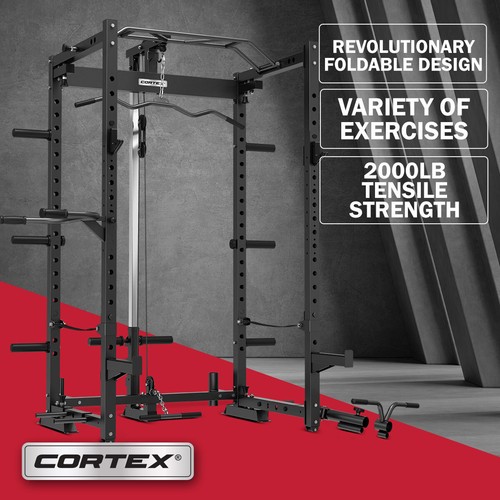
Cortex · Power racks & cages · Folds away
Cortex PR-4 Foldable Squat & Power Rack
227 cm tall · height source
Enter your ceiling height to check this rack.
$1,099
Centra · Squat stands
Centra Adjustable Squat Rack and Bench Press Stand
159 cm tall · height source
Enter your ceiling height to check this rack.
$198.99
How tall is a power rack?
The 3 power racks and half racks we list in Australia run from 210 cm to 227 cm tall, as their makers or retailers list them. The one squat stand or other squat rack is 159 cm. Check the height of the exact model before you buy: the same name can come in more than one height.
Short power racks for a low ceiling
The shortest power racks and half racks we list in Australia, by listed height:
- Costway 900 kg Power Cage with Cable Crossover System and Leg Hold-down, 210 cm
- Trojan TRXL7 Power Rack + Lat Pull Down Combo, 217 cm
- Cortex PR-4 Foldable Squat & Power Rack, 227 cm
Enter your ceiling above to see the full fit list with your own gap and pull-up room.
Will a power rack fit a 2.1 m or 2.4 m ceiling?
With the tool's starting gap of 5 cm above the rack and no pull-ups:
- Under a 2.1 m ceiling (210 cm): none of the 3 power racks and half racks fit, and the squat stand or squat rack does.
- Under a 2.4 m ceiling (240 cm): all 3 power racks and half racks fit, and the squat stand or squat rack does.
Pull-ups on the top bar need more: add your head room, or tick Pull-ups above.
Rack ceiling height questions
How tall is a power rack?
The 3 power racks and half racks we list in Australia run from 210 cm to 227 cm tall, as their makers or retailers list them. The one squat stand or other squat rack is 159 cm. Check the height of the exact model before you buy.
What ceiling height do I need for a power rack with pull-ups?
The rack's height plus the room your head needs above the bar at the top of a pull-up. This tool starts that head room at 30 cm, our assumption, which you can change. On that basis the shortest rack we list in Australia needs a ceiling of about 240 cm and the tallest about 257 cm. Enter your own head room in the tool for your answer.
Can I put a power rack on mats under a low ceiling?
Yes, but the mats lift the rack, so their thickness comes off your ceiling height. Enter it under Mats or platform and the tool takes it off before it compares. Thin rubber tiles take less of the room than a raised lifting platform.
What is the shortest power rack you list?
In Australia, the Costway 900 kg Power Cage with Cable Crossover System and Leg Hold-down, at 210 cm as listed. Squat stands go lower, from 159 cm, but have no cage or top bar for pull-ups.
How this works
What it works out
- Room above the mats: your ceiling height minus anything the rack stands on. A rack on a platform sits that much closer to the ceiling.
- Tallest rack: that room minus the gap you choose to keep. The gap is yours to set: it covers things like bolt heads and caps on top of the uprights, a floor that is not level, and light fittings. We start it at 5 cm only so the box is not empty; no standard sets it.
- Pull-ups: at the top of a pull-up your chin is over the bar, so your head is above it. The tool checks that the gap between the top of the rack and the ceiling is at least the head room you enter. It treats the rack's listed height as the bar height. Many racks put the pull-up bar at or below the top, which only adds room; if a product page shows a bar above the frame, check that figure.
- Overhead press: inside a rack the bar is wider than the frame, so at lockout it must pass below the top cross bars. The tool checks your standing reach plus the same gap you set above the rack against the rack's height: one gap, used both above the rack and between your reach and its top bars. Fingertip reach is a little higher than the bar in your hands, so the check leans on the cautious side. Outside the rack it checks your reach plus your gap against the ceiling. Plates sit higher than the bar by half their diameter, so if you press with large plates, add half your plate's diameter to the gap.
- Your height: a rack shorter than you means ducking under its top to step in. Pairs of separate stands and connected squat or bench-press stands have no top bar, so the pull-up, press and step-in checks do not apply to them, and the pull-up head room does not count against them: they only need the gap you keep.
- Standing it up once built: a frame assembled lying down sweeps through the diagonal of its height and its shorter side as you tip it up (plain geometry). Where that is taller than your room, the row says to assemble it upright.
How to measure
- Measure from the floor to the ceiling where the rack will stand, at more than one point. Use the lowest figure.
- Look up: a beam, a light fitting, a sloped ceiling, a garage door track or opener all count as the ceiling if they are over the rack.
- For reach, stand on the mats you will lift on, feet flat, arms straight up, and mark your fingertips on a wall. Measure to the mark.
Sources
- Rack heights: each listed height comes from the maker's or retailer's page, stored with a receipt on our product record. Every rack above links to the page its height came from.
- Inches and centimetres: one inch is 2.54 centimetres, from NIST Guide to the SI, Appendix B.8.
- Prices are the stores' listed prices when we last checked them, shown only beside a live offer.