
We may earn a commission when you buy through these links, at no extra cost to you. Prices and details change often: check the product and price on the retailer's page before you buy (accuracy). How we make money
On this page
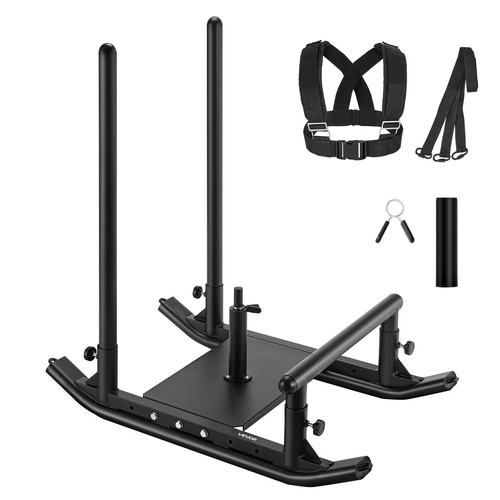
In Australia, the VEVOR Weight Pull Push Sled is the sled to look at: a 23 kg powder-coated steel push and drag sled with two upright handles, a low T-handle, four corner pull hooks and a padded harness, with posts for 25 mm and 51 mm plates. VEVOR rates it to 125 kg. It is the only sled in this guide sold from inside Australia so far.
A push sled has upright poles or a handle that you drive forward. A drag sled is pulled behind you on a strap, rope or harness. Many plate-loaded sleds do both.
Our picks
 Best overall
A push and drag sled with upright handles, a low T-handle and a padded harness with shoulder straps in the box, and posts for both 25 mm and 51 mm plates. VEVOR rates it to 125 kg.
from$184.99
How to choose a weight sled
- Push, drag or both. A push sled needs upright poles or a handle; a drag sled needs a strap point for a rope or harness. A sled with both does either on the same frame. Check whether the harness, rope or extra bars are included, as several makers sell them separately.
- Surface. Makers list the surfaces a sled is meant for, such as grass, artificial turf, concrete, asphalt, rubber, track or sand. Use one the maker lists. Some sleds come with plastic ski liners or a skid plate and some sell them separately, so check which you get.
- Plate post. Olympic plates have a 50 mm (2 in) hole. Check the post or pin takes your plates and how long it is, since a longer post holds more plates. A painted post can be a tight fit for some plates.
- Load capacity. Not every maker publishes one. Where a maker does, it is in the comparison table; where it does not, we leave it blank rather than guess.
- Handle height. High poles set a more upright push and a low bar or handle sets a lower one. Removable poles also make the frame easier to store.
- Space and storage. A plate-loaded push sled can be about a metre long and weigh over 30 kg empty, so plan a clear, flat lane to push it along and somewhere to keep it. Our home gym planner helps you plan the floor space. A drag sled is smaller and lighter to put away.
If you own standard 25 mm plates as well as Olympic ones, the VEVOR Weight Pull Push Sled has a post for each, and its harness comes in the box.
Sleds for grass, turf and concrete
Makers list the surfaces each sled is built for, so match the sled to the lane you have. These are the surfaces each maker names.
VEVOR Weight Pull Push Sled: gyms, artificial turf and tracks.
If you want a sled with wheels
None of the makers here lists wheels on its sled: these sleds slide on their base, skis or a skid plate. If you want one that is easy to move between sessions, the lightest sled in your market is the one to look at.
In Australia the only sled here so far is the VEVOR Weight Pull Push Sled, at 23 kg.
VEVOR Weight Pull Push Sled: best overall
A Q235 steel sled with a powder coat, 103 x 66 x 104 cm and 23 kg, with two upright handles for a high push, a low T-handle, four corner pull hooks and a padded harness with adjustable shoulder straps. It has support bars for 25 mm and 51 mm plates, so it takes standard and Olympic plates. VEVOR rates it to 125 kg and lists it for gyms, artificial turf and tracks.
Pros
- Posts for 25 mm and 51 mm plates
- Harness with shoulder straps included
- Upright handles and a low T-handle
Cons
- Rated to 125 kg of load
- VEVOR does not list the surfaces it should not be used on
Frequently asked questions
Push sled or drag sled: which do I need?
A push sled has upright poles or a handle that you drive forward. A drag sled is pulled behind you on a strap, rope or harness. Many plate-loaded sleds take both, with poles in sockets and attachment points for a harness. If you only want pulls and drags, a drag sled is smaller and lighter to store.
Can you use a weight sled on concrete?
Only where the maker lists concrete or other hard surfaces, so check the product page first. Some sleds come with plastic ski liners or a skid plate and some sell them separately.
Can you use a weight sled on grass?
Yes, where the maker lists grass or turf. The surface changes how much the same load resists, so pushing on one lane each time keeps sessions comparable.
Are there weight sleds with wheels?
None of the makers here lists wheels on its sled: these sleds slide on their base, skis or a skid plate. If moving the sled between sessions matters, look for one that breaks down or a light drag sled.
Is a weight sled worth it for a home gym?
It suits you if you have a clear, flat run outdoors or in a long garage and already own Olympic plates, since the makers that say so do not include plates. It suits you less if you have no space to push a sled several metres or nowhere to store a frame about a metre long. A drag sled is the smaller option where storage is tight.
How we chose
We have not tested these sleds. We compared the makers' own specifications: push or drag, sled weight, frame size, plate post, rated capacity and the surfaces each maker lists, and kept only sleds sold new by a seller inside each market. Where a maker does not state a figure, such as a load capacity or sled weight, we leave it out rather than guess.
Related tools
Get price drops on this kit by email
Prices change. We'll email you when one we compare drops, only when it's worth sending.