
We may earn a commission when you buy through these links, at no extra cost to you. Prices and details change often: check the product and price on the retailer's page before you buy (accuracy). How we make money
On this page
Match the floor to what goes on it. Lifting free weights needs solid rubber: tiles of 15 mm (5/8 in) or more, a lifting platform for heavy pulls, or drop pads if you drop the bar. A treadmill, bike or rower needs only a thin equipment mat sized to its footprint, and floor work and light dumbbells suit cushioned foam tiles.
For a UK home gym that lifts free weights, FORZA's 20 mm solid rubber tiles cover the floor: a 1 m square tile of 17.5 kg, or 50 cm tiles in packs of four that are easier to lift and fit around a rack. Under a treadmill, bike, rower or cross trainer, York Fitness's 5 mm rubber mat or JLL's 6 mm waterproof PVC mat protects the floor, and JLL's 8 mm rubber tile is a solid rubber option for a cardio corner.
Where a dropped bar lands, Strength Shop's Soft Drop Pads are made for bumper plates only, and GYM MASTER's PVC crash pads are the tallest barbell pads we list.
Our picks
 Best rubber tiles for lifting
A 1 x 1 m solid rubber tile, 20 mm thick and 17.5 kg, of 95% recycled SBR and 5% EPDM with ventilation grooves, which FORZA rates for medium to heavy strength training. Sold one tile at a time, so you buy the area you need.
from£36.99 Easiest rubber tiles to lay
The same 20 mm FORZA rubber in 50 x 50 cm tiles, four to a pack covering 1 m². Smaller tiles are easier to carry, lay and fit around a rack than 1 m squares.
from£39.99 Best thin rubber tiles
A 1 x 1 m recycled rubber tile, 8 mm thick, with straight-cut edges, sold singly. Solid rubber for a cardio corner or bodyweight area rather than for heavy lifting.
from£15.49 Best mat for a cardio machine
York Fitness
York Fitness Large Equipment & Exercise Mat
A 182 x 76 cm textured rubber mat, 5 mm thick, that York sizes for benches, treadmills, bikes, rowers and cross trainers. It rolls up for storage.
from£23.99 Best waterproof machine mat
A 180 x 80 cm mat of high-density PVC, 6 mm thick, with a non-slip texture on both sides. JLL makes it for treadmills, exercise bikes, cross trainers and rowers, and it rolls up.
from£29.99 Best drop pads
Strength Shop
Strength Shop Soft Drop Pads
A pair of foam-filled pads, each 75 x 60 x 15 cm, with a vented cover, low rebound and Velcro strips for stacking. Strength Shop rates each pad to 120 kg, for bumper plates only.
from£142.99 Tallest drop pads
A pair of high density foam pads, each 75 x 59.5 cm and 16 cm high, the tallest barbell drop pads we list, in a PVC cover with carry handles and a YKK zip.
from£99.99
| Model | FORZAFORZA Rubber Gym Flooring Mat [1m x 1m], 20 mm | FORZAFORZA Rubber Gym Flooring Mats [50cm x 50cm], Pack of 4, 20 mm | JLLJLL Rubber Gym Floor Tile, 1m x 1m, 8 mm Straight Cut | York FitnessYork Fitness Large Equipment & Exercise Mat | JLLJLL Cardio Machine Mat | Strength ShopStrength Shop Soft Drop Pads | GYM MASTERGYM MASTER Pair of Weight Lifting Crash Pads (Black) |
|---|---|---|---|---|---|---|---|
| Best price | £36.99 | £39.99 | £15.49 | £23.99 | £29.99 | £142.99 | £99.99 |
| Check price | |||||||
| Material | Rubber (95% recycled SBR, 5% EPDM) | Rubber (95% recycled SBR, 5% EPDM) | Rubber (recycled) | Rubber | Vinyl (PVC) | Foam filling, vented plastic cover | High density foam, PVC cover |
| Thickness | 20 mm | 20 mm | 8 mm | 5 mm | 6 mm | 150 mm | 160 mm |
| Tile size | 100 cm | 50 cm | 100 cm | Not listed | Not listed | Not listed | Not listed |
| Footprint | Not listed | Not listed | Not listed | 182 x 76 cm | 180 x 80 cm | 75 x 60 cm | 75 x 59.5 cm |
How to choose home gym flooring
- What goes on it. Free weights and barbells need solid rubber. A treadmill, bike, rower or bench needs a mat that covers its footprint. Stretching, bodyweight work and light dumbbells suit foam tiles, and for floor work alone our gym mats guide covers exercise mats. A mixed room can use more than one: rubber where you lift, a mat under the machine.
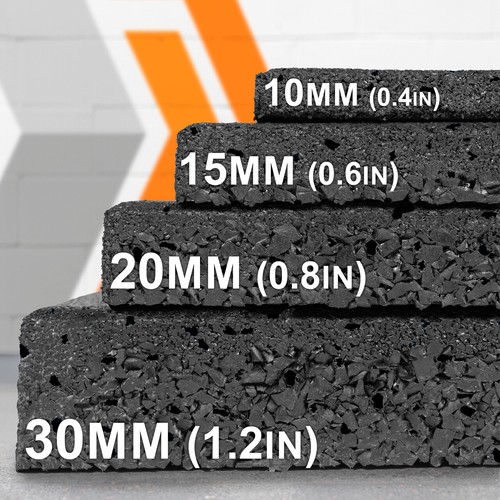
- Thickness. The flooring we list runs from 5 mm (0.2 in) equipment mats to 50 mm (about 2 in) rubber tiles, and drop pads are about 15 cm (6 in) deep. For a garage lifting floor we suggest solid rubber of 15 mm (5/8 in) or more. The makers of the thin mats describe them as floor protectors for machines, not as flooring for dropped weights.
- Material. Solid rubber is dense and heavy: a 23.5 in rubber tile we list weighs 12.7 kg (28 lb), while a 24 in EVA foam tile weighs 0.23 kg (0.5 lb). Foam is light and cushioned and easy to lift out and store. Rubber-topped foam tiles sit between the two. TPE, PVC and closed-cell foam mats are thin, light and wipe clean.
- Format. Square tiles lie edge to edge. Interlocking tiles have puzzle edges and come with border strips for a straight outer edge. Large mats are one piece for one machine. Rolls cover a long strip, such as a turf lane for a sled.
- Area. Measure the space and divide by the tile size, then add a few spare tiles for cuts. Our gym flooring calculator works this out for your room and tile size, with a waste allowance you choose.
Our pick for each case. Free weights and a rack: the FORZA 20 mm rubber tiles, in 1 m squares or the 50 cm four-pack, which is easier to fit around a rack. A solid rubber cardio corner: the JLL 8 mm tile. Treadmill or bike: the York mat, or the JLL mat if you want a waterproof PVC surface. Dropping the bar with bumper plates: the Strength Shop pads. The tallest barbell pads: GYM MASTER.
FORZA Rubber Gym Flooring Mat 1m x 1m, 20 mm: best rubber tiles for lifting
A single 1 x 1 m tile of solid rubber, 20 mm thick and 17.5 kg, made from 95% recycled SBR rubber and 5% EPDM, with integrated ventilation grooves. FORZA rates the 20 mm tile for medium to heavy strength training and sells it one tile at a time in black, blue or grey fleck. Each tile covers 1 m², so a lifting area has few joins.
FORZA says sizes can vary by up to 1% from the cooling process, and it states a 6-month warranty. At 17.5 kg a tile, plan how you will carry and cut them.
Pros
- Solid rubber, 20 mm thick
- Each tile covers 1 m², so few joins in a lifting area
- Integrated ventilation grooves
Cons
- 17.5 kg per tile to carry and cut
- FORZA states a 6-month warranty
- Sizes can vary by up to 1% from the cooling process, as FORZA says
FORZA Rubber Gym Flooring Mats 50cm x 50cm, Pack of 4: easiest rubber tiles to lay
The same 20 mm FORZA rubber (95% recycled SBR, 5% EPDM, with ventilation grooves) cut into 50 x 50 cm tiles, four to a pack, so each pack covers 1 m². Smaller tiles are easier to lift, lay and fit around the feet of a rack. FORZA says they suit indoor or outdoor use, does not state a tile weight and gives a 6-month warranty. A room takes several packs.
Pros
- Solid rubber, 20 mm thick
- Smaller 50 cm tiles are easier to handle than 1 m tiles
- Integrated ventilation grooves
Cons
- Four tiles cover only 1 m², so a room takes several packs
- FORZA states a 6-month warranty
- FORZA does not state a tile weight
JLL Rubber Gym Floor Tile 1m x 1m, 8 mm: best thin rubber tiles
A single 1 x 1 m recycled rubber tile, 8 mm thick, with straight-cut edges; JLL sells an interlocking-edge version separately. It is solid rubber rather than foam, which suits a cardio machine corner or bodyweight work. At 8 mm it is thinner than the 15 mm we suggest for free weights, and JLL does not state a tile weight.
Pros
- Solid rubber rather than foam
- Each tile covers 1 m²
- Straight-cut edges rather than a jigsaw join
Cons
- 8 mm thick: thinner than the 15 mm we use as the free-weights threshold
- JLL does not state a tile weight
York Fitness Large Equipment & Exercise Mat: best mat for a cardio machine
A 182 x 76 cm mat of textured anti-slip rubber, 5 mm thick, that York sizes for benches, treadmills, exercise bikes, rowers and cross trainers. It also works as a floor exercise mat and rolls up for storage.
Check your machine sits inside 182 x 76 cm before you buy: York makes it in one size. At 5 mm it is too thin for dropped weights.
Pros
- Sized by York for benches, treadmills, bikes, rowers and cross trainers
- Textured anti-slip rubber
- Rolls up for storage
Cons
- 5 mm is thin for dropped weights
- One size only: 182 x 76 cm
JLL Cardio Machine Mat: best waterproof machine mat
A 180 x 80 cm mat of high-density PVC, 6 mm thick, with a non-slip texture on both sides. JLL makes it to go under a treadmill, exercise bike, cross trainer or rowing machine, and says the surface is waterproof and sweat resistant.
It is one size and rolls up for storage. At 6 mm it protects the floor under a machine; it is not flooring for dropped weights.
Pros
- 180 x 80 cm, sized for a treadmill, bike, cross trainer or rower
- Non-slip texture on both sides
- Waterproof surface that wipes clean, and rolls up
Cons
- 6 mm is thin for dropped weights
- One size only
Strength Shop Soft Drop Pads: best drop pads
A pair of foam-filled pads, each 75 x 60 x 15 cm, in a vented plastic cover with Velcro strips for stacking. Strength Shop rates each pad to 120 kg, says they are low rebound and for bumper plates only, and sells stopper wedges separately.
Pros
- Sold as a pair
- Velcro strips to stack pads
- Low-rebound foam with air vents
Cons
- For bumper plates only
- Maximum recommended load 120 kg per pad
- Stopper wedges cost extra
GYM MASTER Weight Lifting Crash Pads: tallest drop pads
A pair of high density foam pads, each 75 x 59.5 cm and 16 cm high, the tallest barbell drop pads we list, in a PVC cover with carry handles and a YKK zip. GYM MASTER gives no maximum load and says they are not for commercial use.
Pros
- Sold as a pair
- 16 cm high, the tallest barbell drop pads we list
- Zipped PVC cover and carry handles
Cons
- No maximum load given by GYM MASTER
- Not for commercial use, per GYM MASTER
Frequently asked questions
How thick should home gym flooring be?
It depends on what goes on it. Under a treadmill, bike or rower, the equipment mats we list are 5 to 6.35 mm (about 1/4 in), which their makers describe as floor protection. For free weights, use solid rubber: we suggest 15 mm (5/8 in) or more, and the thickest tiles we list are 50 mm (about 2 in) in Australia, 40.6 mm (1.6 in) in the US and 20 mm in the UK. If you drop the bar, add drop pads, about 15 cm (6 in) deep, or a lifting platform.
Rubber or foam gym flooring?
Rubber for lifting, foam for floor work. Solid rubber tiles are dense and heavy; one 23.5 in rubber tile we list weighs 12.7 kg (28 lb). EVA foam tiles are light, at 0.23 kg (0.5 lb) for a 24 in tile, cushioned and easy to lift and store, which suits stretching, bodyweight work and light dumbbells but not dropped weights. Rubber-topped foam tiles sit between the two.
What is the best flooring for a garage gym?
For lifting on a concrete slab, solid rubber of 15 mm (5/8 in) or more where you train, with a lifting platform or drop pads where the bar lands on heavy pulls. A thin equipment mat is enough under a cardio machine, and a turf roll gives you a lane for sled pushes. The picks above show which of these we list in your market.
How many gym floor tiles do I need?
Divide the floor area by the area of one tile, round up, and add a few spare tiles for cuts at the walls. A 24 in (61 cm) tile covers 4 sq ft, so 48 sq ft takes 12 tiles before spares. Our gym flooring calculator does the sum for your room and tile size with a waste allowance you choose.
Can you use horse stall mats for a home gym?
Horse stall mats are large solid rubber mats sold for stables, and some home gym owners lay them as lifting flooring. We do not list any yet, so we cannot compare their specs here. Judge one as you would a gym tile: thickness, size and weight per mat, and whether the seller states what it is made of.
Is home gym flooring worth it?
If you lift free weights, or have a machine on a floor you want to protect, yes: rubber or a mat sits between the load and your floor. A machine mat only has to cover the machine, so measure its footprint first; the picks above cover lifting, drops and machines. If you only do bodyweight work, a single exercise mat may be all you need, and our gym mats guide covers those.
How we chose
We have not tested this flooring. We compared each maker's published material, thickness, tile or mat size, weight, pack contents and warranty, and kept only products sold new from inside each market. Where a maker does not state a figure, such as a load rating, we leave it out rather than guess. The budget award ranks by the maker's list price in that market.
Related tools
Get price drops on this kit by email
Prices change. We'll email you when one we compare drops, only when it's worth sending.
Sources
- Titan Fitness Deadlift Platform: frame sizes, tiles and band pegs
- Titan Fitness Rubber Lifting Tiles: tile size, thickness and weight
- Strength Shop Soft Drop Pads: load per pad and bumper plates only
- VEVOR 0.56 in gym floor tiles, 25-tile pack (HRD-XJD6614-25W): tile size, thickness, coverage and materials
- Everfit Exercise Equipment Mat 1.8 m (MAT-A-180-BK): size, thickness and material