
Home gym tools
One rep max calculator (1RM) and percentage chart
Enter a set you have already lifted to estimate your one rep max with seven published formulas side by side, then plan working sets from the percentage and rep max charts.
Estimated one rep max
115.5 kg
Mean of seven formulas. Range 112.5 kg to 119 kg. About 254.6 lb.
| Formula | Working | Estimate | vs mean |
|---|---|---|---|
| Epley | w × (1 + r / 30) | 116.7 kg | +1% |
| Brzycki | w × 36 / (37 − r) | 112.5 kg | -2.6% |
| Landers | w / (1.013 − 0.0267123 r) | 113.7 kg | -1.5% |
| Lombardi | w × r^0.10 | 117.5 kg | +1.7% |
| Mayhew et al. | w / (0.522 + 0.419 e^(−0.055 r)) | 119 kg | +3% |
| O'Conner et al. | w × (1 + 0.025 r) | 112.5 kg | -2.6% |
| Wathen | w / (0.4880 + 0.538 e^(−0.075 r)) | 116.6 kg | +0.9% |
Kit rated for a 119 kg lift
Bars and racks on sale here whose maker states a capacity at or above the highest estimate, lowest listed price first. The bar and rack carry the whole load, so the rating has to cover the heaviest weight you put on them.
Barbells
 £91.99
 £145.99
Power and squat racks
 £116.99
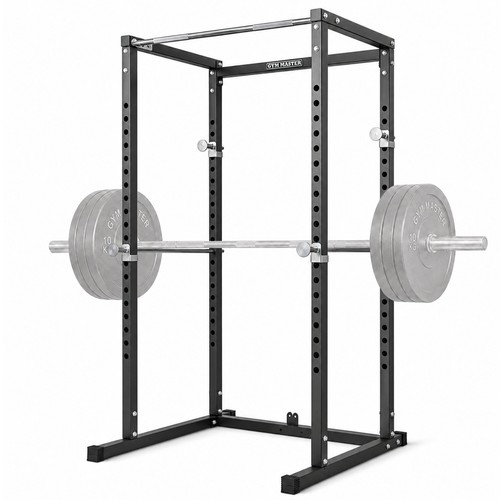 £189.99
1RM percentage chart
Shares of your estimated max, for planning working sets, rounded to the nearest 2.5 kg. Load any row with the plate calculator.
| % of 1RM | Load (rounded) | Exact |
|---|---|---|
| 100% | 115 kg | 115.5 kg |
| 95% | 110 kg | 109.7 kg |
| 90% | 105 kg | 103.9 kg |
| 85% | 97.5 kg | 98.2 kg |
| 80% | 92.5 kg | 92.4 kg |
| 75% | 87.5 kg | 86.6 kg |
| 70% | 80 kg | 80.8 kg |
| 65% | 75 kg | 75.1 kg |
| 60% | 70 kg | 69.3 kg |
| 55% | 62.5 kg | 63.5 kg |
| 50% | 57.5 kg | 57.7 kg |
Rep max chart
The load the formulas expect for each number of reps, run backwards from your estimated max. The load is rounded like the percentage chart; the range is exact.
| Reps | Load (rounded) | Range (exact) |
|---|---|---|
| 1 | 115 kg | 115.5 kg to 115.5 kg |
| 2 | 110 kg | 103.6 kg to 112.3 kg |
| 3 | 105 kg | 101.3 kg to 109.1 kg |
| 4 | 102.5 kg | 99.1 kg to 105.9 kg |
| 5 your set | 100 kg | 97 kg to 102.7 kg |
| 6 | 97.5 kg | 95.1 kg to 100.4 kg |
| 7 | 95 kg | 93.1 kg to 98.3 kg |
| 8 | 92.5 kg | 90.5 kg to 96.2 kg |
| 9 | 90 kg | 88 kg to 94.3 kg |
| 10 | 87.5 kg | 85.7 kg to 92.4 kg |
| 11 | 85 kg | 83.1 kg to 90.9 kg |
| 12 | 85 kg | 80 kg to 90.1 kg |
Load these weights
All weight platesTo move in 2.5 kg jumps you need a pair of 1.25 kg plates, one each side. Ranges whose smallest stated plate does that come first. Check each listing has the sizes you need.

Exersci
Exersci Premium Retro 2" Cast Iron Weight Plates (Pair)
Smallest plate 1.25 kgMakes your jump
£43.95 £67.99
 £101.99

GYM MASTER
GYM MASTER Cast Iron 2" Olympic Tri-Grip Weight Plates
Smallest plate 1.25 kgMakes your jump
£79.99
Testing a true single? Use a spotter. [1] Lifting alone at home? Compare power cages, read our power rack guide, or add spotter arms to a rack you have.
Spotter arms for your rack
All spotter arms and safetiesArms that fit the rack uprights and sit just below the bar. Match the upright and hole size to your rack.
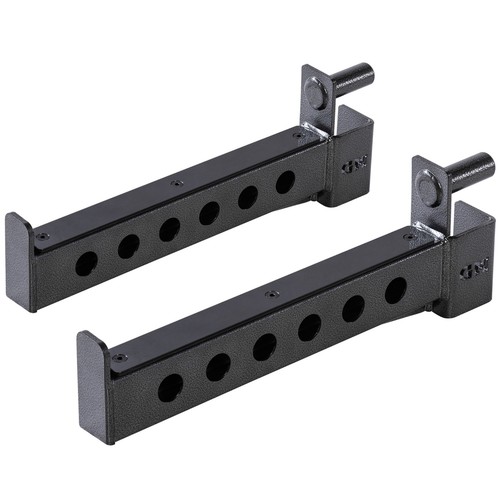 £29.99
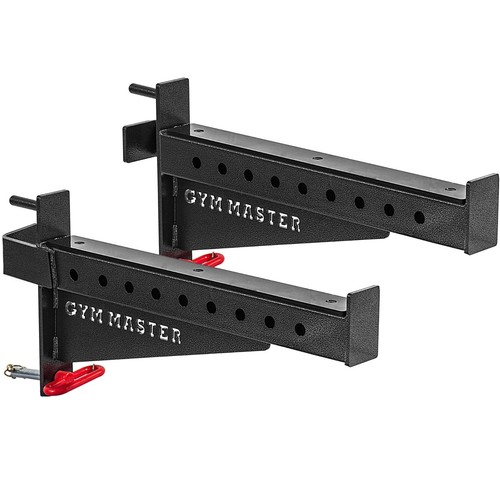 £71.99
One rep max questions
What is a one rep max?
A one rep max (1RM) is the heaviest weight you can lift for one full repetition of an exercise. Training plans often set working loads as a percentage of it, which is what the percentage chart on this page is for. [1]
How do you calculate 1RM?
Either test it directly, working up through heavier and heavier singles with several minutes of rest between attempts, or estimate it from a set of several reps with a formula. The Epley formula, for example, multiplies the weight lifted by one plus the reps divided by thirty. This calculator runs seven such formulas on the set you enter. [1]
Which 1RM formula is most accurate?
No one formula is the most accurate for everyone. Epley and Brzycki are the most commonly used, and any estimate can differ from a tested max by ten percent or more. A formula made for the specific exercise is more accurate, which is why this calculator shows seven general formulas side by side with their range rather than one number. [1]
Is the Epley or Brzycki formula higher?
They give the same answer at ten reps. For fewer than ten reps Epley comes out slightly higher, and above ten reps Brzycki does. A set of 100 for 6 reps, in whichever unit you lift, gives about 120 by Epley and about 116 by Brzycki. [1]
Every figure here is an estimate worked out from the set you enter, not a measured max. The formulas spread further apart as reps rise, so a heavier set of fewer reps gives a tighter range.
How this works
How to calculate your one rep max
A one rep max (1RM) is the heaviest weight you can lift for one full repetition. Testing it directly means working up through heavier and heavier singles with rest between attempts, which takes time. The usual shortcut is to take a set of several reps and estimate the max from it with a formula, which is what this calculator does. [1]
One rep max formulas: Epley, Brzycki and five more
Each formula multiplies the weight you lifted (w) by a factor that grows with the reps you did (r), so the answer comes out in whatever unit you entered. We use seven formulas as tabulated on Wikipedia [1], show each one, and lead with their mean and the range between the lowest and highest. For a single, every formula returns the weight lifted, since a single is the max.
- Epley:
w × (1 + r / 30) - Brzycki:
w × 36 / (37 − r) - Landers:
w / (1.013 − 0.0267123 r) - Lombardi:
w × r^0.10 - Mayhew et al.:
w / (0.522 + 0.419 e^(−0.055 r)) - O'Conner et al.:
w × (1 + 0.025 r) - Wathen:
w / (0.4880 + 0.538 e^(−0.075 r))
The rep max chart runs each formula backwards: from your estimated max it gives the load each formula expects for every rep count from one to twelve, and shows their mean and range. The percentage chart is plain arithmetic on the estimated max, rounded to the jump you choose (the rep max chart uses the same rounding). Each row is a load you can make if your smallest plates weigh half that jump, one on each side; the plate calculator shows which plates go on.
How far to trust it
Epley and Brzycki are the two most used formulas and give the same answer at ten reps; below ten, Epley comes out slightly higher. The formulas diverge more past about ten reps, and an estimate can vary from a tested max by ten percent or more, which is why this calculator stops at twelve and shows the spread rather than one number. [1] Two studies point the same way: one found a set of five predicted the max more closely than sets of ten or twenty, and its authors advise using no more than ten reps [2]; the other found the equations more accurate from sets of fewer than ten [3]. For the closest estimate, enter a heavy set of ten reps or fewer. If you do test a true max, a spotter helps. [1]
Sources
- One-repetition maximum, Wikipedia (read 15 November 2026): the definition, the formula table and coefficients, the Epley and Brzycki comparison, estimates varying by ten percent or more, exercise-specific formulas, direct testing and spotters. It credits Epley to B. Epley, Poundage Chart (1985), and Brzycki to M. Brzycki, A Practical Approach to Strength Training (1998).
- Reynolds, Gordon and Robergs (2006), Prediction of one repetition maximum strength from multiple repetition maximum testing and anthropometry, Journal of Strength and Conditioning Research 20(3), 584 to 592 (abstract read 15 November 2026): 70 adults tested at 1, 5, 10 and 20 rep max on bench press and leg press; the 5 rep max gave the most accurate prediction. PubMed 16937972, doi:10.1519/R-15304.1
- Mayhew, Johnson, LaMonte, Lauber and Kemmler (2008), Accuracy of prediction equations for determining one repetition maximum bench press in women before and after resistance training, Journal of Strength and Conditioning Research 22(5), 1570 to 1577 (abstract read 15 November 2026): 103 women tested before and after 12 weeks of training; prediction equations were more accurate when fewer than ten repetitions were used. PubMed 18714230, doi:10.1519/JSC.0b013e31817b02ad