We may earn a commission when you buy through these links, at no extra cost to you. Prices and details change often: check the product and price on the retailer's page before you buy (accuracy). How we make money
On this page
A balance board gives you an unstable surface to stand, kneel or brace on. Choose a half-ball trainer if you want one piece for standing, kneeling and floor exercises, a round wobble board if you want something small and light that tips in every direction, a long or rocker board if you want to stand with your feet apart, and a foam pad or air cushion if you want the lowest option that doubles as a kneeling cushion. Our picks for each type are below.
Our picks
 Best overall
The original 65 cm (25.5 in) half ball from BOSU, 21.6 cm (8.5 in) high on six rubberised feet, with a 136 kg (300 lb) maximum load and a 1 year home-use warranty.
from$139.99- Best adjustable balance board
A 70 x 24 cm multi-layer wood deck on a 13.6 cm round base that tilts and turns through 360 degrees, with three height settings and a 200 kg weight capacity.
 Best with bands included
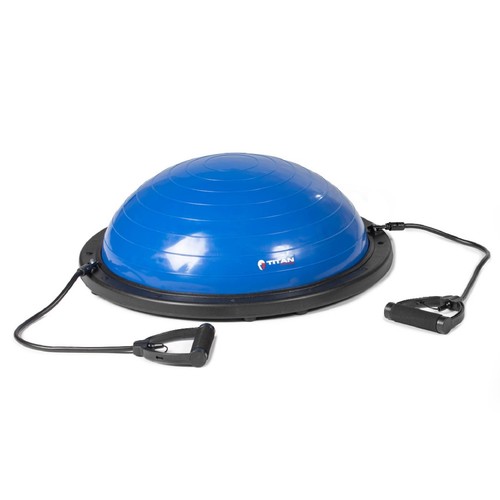
Titan Fitness
Titan Fitness Blue Balance Ball Trainer
A 23.5 in (59.69 cm) half ball with two resistance bands that attach to the base and a pump in the box, rated to 350 lb (158.76 kg).
from$94.99 Best for small spaces
BOSU's travel-size 50 cm (19.7 in) half ball at 4.54 kg (10 lb), with a 113.4 kg (250 lb) maximum load.
from$106.99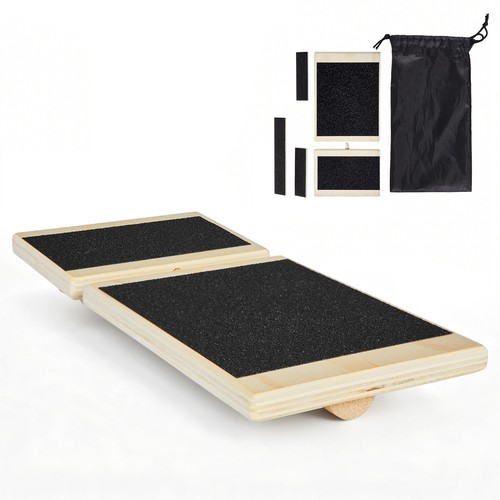 Best for one foot
A 30 x 14 cm wooden rocker, 3 cm high and 0.38 kg, sized for one foot, with a hook-and-loop difficulty setting, a storage bag and a 200 kg rating.
from$12.90 Best balance pad
BOSU
BOSU Balance Pad
A 40 x 33 x 5 cm (15.75 x 13 x 2 in) TPE foam pad at 0.27 kg (0.6 lb) that BOSU also sells as a seat cushion or knee pad.
from$32.99 Best for gym use
The same 65 cm (25.5 in) BOSU dome on an over-moulded, non-marking base BOSU designs for commercial use, rated to 159 kg (350 lb) against 136 kg for the HOME.
from$199.99
| Model | BOSUBOSU HOME Balance Trainer | VEVORVEVOR 3-Level Adjustable Wobble Balance Board PH-7 (28 in) | Titan FitnessTitan Fitness Blue Balance Ball Trainer | BOSUBOSU SPORT Balance Trainer 50 cm | VEVORVEVOR Foot and Ankle Balance Board PH-9 (12 in) | BOSUBOSU Balance Pad | BOSUBOSU PRO Balance Trainer |
|---|---|---|---|---|---|---|---|
| Best price | $139.99 | — | $94.99 | $106.99 | $12.90 | $32.99 | $199.99 |
| Check price | No listed price | ||||||
| Type | Half ball | Balance board | Half ball | Half ball | Balance board | Balance pad | Half ball |
| Max user | 300 lb (136 kg) | 441 lb (200 kg) | 350 lb (158.76 kg) | 250 lb (113.4 kg) | 441 lb (200 kg) | Not listed | 351 lb (159 kg) |
| Height | 8.5 in (21.6 cm) | Not listed | 10.5 in (26.67 cm) | 7 in (17.8 cm) | 1.2 in (3 cm) | 2 in (5 cm) | 8.5 in (21.6 cm) |
| Weight | 13 lb (6 kg) | 4 lb (1.9 kg) | 12 lb (5.44 kg) | 10 lb (4.54 kg) | 1 lb (0.38 kg) | 0.5 lb (0.27 kg) | 15.5 lb (7 kg) |
| Diameter | 25.6 in (65 cm) | Not listed | 23.5 in (59.69 cm) | 19.7 in (50 cm) | Not listed | Not listed | 25.6 in (65 cm) |
| Footprint | Not listed | 27.6 x 9.4 in (70 x 24 cm) | Not listed | Not listed | 11.8 x 5.5 in (30 x 14 cm) | 15.7 x 13 in (40 x 33 cm) | Not listed |
How to choose a balance board for adults
- Type. A half-ball trainer is an inflated dome on a flat, rigid base. A wobble board is a round deck on a dome or pivot that tips in every direction. A long balance board has a deck you stand across with your feet apart; a rocker board rides on a separate roller and rolls as well as tips. A plank board is made for your forearms rather than your feet. A foam pad or air cushion is a soft, low surface with no pivot at all.
- Size. Diameter or deck size sets how much room you have for your feet and hands. Half balls are commonly 50 to 65 cm across and round wobble boards about 40 cm; a long board is wider than either.
- Height. A taller board puts you further off the floor. A foam pad is the lowest, a round wobble board sits a little higher, and a half ball or a long board on a roller or pivot sits highest. The compare table shows each pick's published height.
- User limit. Stay within the limit the maker states. Some makers publish none, and we say so in the pick; the compare table shows each published figure.
- Weight and storage. A round wobble board or a foam pad is small enough to slide under a bed or desk. A half ball is bulkier and heavier, and takes a corner or a wall bracket.
- What comes in the box. Some half balls include resistance bands and a pump; some wobble boards have carry handles or hand ropes. Check before you buy extras separately; our resistance bands guide compares bands sold on their own.
- Warranty. Check the maker's warranty length and whether it covers home use only; some makers state none.
Quick picks by need
- Lowest surface, or for a standing desk: the BOSU Balance Pad, 5 cm (2 in) high.
- Feet apart on a long board: the VEVOR PH-7, a 70 x 24 cm deck with three height settings.
- Bands in the box: the Titan Fitness Blue Balance Ball Trainer, with a pump too.
- The biggest dome: the BOSU HOME, 65 cm (25.5 in) across.
- Light and easy to carry: the BOSU SPORT, 50 cm (19.7 in) and 4.54 kg (10 lb).
- One foot at a time: the VEVOR PH-9, 30 x 14 cm.
Best balance board for a standing desk
At a standing desk, height matters most: the taller the board, the further it lifts you from your normal desk height. A pad, an air cushion or a low round board changes it least. Check you can still reach the keyboard comfortably, and use the board on a flat floor.
The VEVOR PH-7 is the US pick whose listing names standing desks: a 70 x 24 cm long deck you stand across with your feet apart, on a base with three height settings that turns through 360 degrees. For the lowest surface, the BOSU Balance Pad is 5 cm (2 in) high, and BOSU says it also works as a seat cushion.
BOSU HOME Balance Trainer: best overall
The HOME trainer is a smooth ribbed, latex-free dome 65 cm (25.5 in) across on a flat base with six rubberised feet. It stands 21.6 cm (8.5 in) high when properly inflated and weighs 6 kg (13 lb). BOSU gives a 136 kg (300 lb) maximum load and a 1 year limited warranty for home use, and makes it in the USA. It is sold in blue and black, matte black or a choice of colour pairs, and BOSU sells a version with resistance bands as a separate product. BOSU also makes a PRO version on a commercial base, covered at the end of the picks.
Pros
- 65 cm (25.5 in) dome with a 136 kg (300 lb) maximum load
- Six rubberised feet on the base
- Many colour options
Cons
- Warranty covers home use only
- Resistance bands are a separate product
VEVOR 3-Level Adjustable Wobble Balance Board: best adjustable balance board
A long deck you stand across with your feet apart: a 70 x 24 cm multi-layer solid wood board in black on a 13.6 cm round base. The base sets at three heights and lets the deck turn through 360 degrees as well as tilt, and both the top and the base are anti-slip. VEVOR rates it to 200 kg and gives a board weight of 1.9 kg, and its listing names standing desks among its uses. VEVOR gives two different sets of height figures, so we list none.
Pros
- Three height settings on the base
- Turns through 360 degrees as well as tilting
- 200 kg weight capacity
Cons
- VEVOR gives conflicting height figures
- At 70 cm long it needs more floor space than a round board
Titan Fitness Blue Balance Ball Trainer: best with bands included
Titan's half ball is 23.5 in (59.69 cm) across and 10.5 in (26.67 cm) high, the tallest of the half balls here, and weighs 12 lb (5.44 kg). It comes with two 23 in rubber resistance bands that attach directly to the base, a skid-free, mark-free base and a pump. Titan gives a 350 lb (158.76 kg) weight capacity. It has the lowest list price of the US half-ball picks.
Pros
- Resistance bands that attach to the base are included
- 350 lb (158.76 kg) weight capacity
- Pump included
Cons
- At 10.5 in (26.67 cm) high, it sits further off the floor than the BOSU domes
- Smaller 23.5 in dome than a 65 cm trainer
BOSU SPORT Balance Trainer 50 cm: best for small spaces
The SPORT is BOSU's travel-size half ball: a 50 cm (19.7 in) dome, 17.8 cm (7 in) high when properly inflated, weighing 4.54 kg (10 lb), on six non-slip feet. BOSU gives a 113.4 kg (250 lb) maximum load, lower than its 65 cm trainers, and a 1 year home-use warranty. It comes in five colour options and is made in the USA.
Pros
- 50 cm and 4.54 kg, so easy to carry and store
- Five colour options
Cons
- 113.4 kg (250 lb) limit
- Smaller standing area than a 65 cm dome
VEVOR Foot and Ankle Balance Board PH-9: best for one foot
The smallest board here: a 30 x 14 cm multi-layer wood board, 3 cm high including its rocking base, sized for one foot at a time. A hook-and-loop setting changes the difficulty, the base is anti-slip rubber and a storage bag comes in the box. It weighs 0.38 kg and VEVOR rates it to 200 kg.
Pros
- 0.38 kg with a storage bag
- Hook-and-loop difficulty setting
- 200 kg weight capacity
Cons
- Sized for one foot, not for standing with both feet
- VEVOR gives no tilt angle
BOSU Balance Pad: best balance pad
BOSU's pad is a 40 x 33 x 5 cm (15.75 x 13 x 2 in) block of flexible TPE foam weighing 0.27 kg (0.6 lb), in black or blue. BOSU describes it as sweat-proof and slip-resistant and says it also works as a seat cushion or knee pad. It gives an approximate weight limit of 440 lb and a 90 day limited warranty.
Pros
- Light at 0.27 kg (0.6 lb)
- Doubles as a kneeling pad
- Sweat-proof, slip-resistant TPE foam
Cons
- 90 day warranty
- BOSU gives only an approximate weight limit
BOSU PRO Balance Trainer: best for gym use
The PRO has the same 65 cm (25.5 in) smooth ribbed dome and 21.6 cm (8.5 in) inflated height as the HOME trainer. The difference is the base: an over-moulded, rubberised, non-skid and non-marking base that BOSU designs for commercial use and daily gym sessions. It weighs 7 kg (15.4 lb), and BOSU gives a 159 kg (350 lb) maximum load against 136 kg (300 lb) for the HOME. Its 1 year limited warranty is not described as home use only. It has a higher list price than the HOME.
Pros
- 159 kg (350 lb) maximum load
- Base designed for commercial use
- Warranty not limited to home use on BOSU's page
Cons
- Higher list price than the HOME
- Heavier at 7 kg (15.4 lb)
Frequently asked questions
Is a balance board worth it?
It suits you if you want a small, light piece of kit for standing, kneeling and floor exercises that stores under a bed or desk. It is not the right buy if you want something to replace a bench, a step or a cardio machine: it is a surface to stand or brace on, nothing more.
What is the difference between a wobble board and a balance board?
A wobble board is round and sits on a dome or pivot, so it tips in any direction. "Balance board" is the wider name: it also covers long boards you stand across, half-ball trainers and foam pads. Makers and shops use the names loosely, so check the shape and the height they state.
Can you use a balance board at a standing desk?
Yes, if the height suits you: our "Best balance board for a standing desk" section above names the picks sold in your country. A foam pad, an air cushion or a low round board keeps you closest to your normal desk height; a half ball or a tall long board lifts you further. Check you can still reach the keyboard comfortably, and stand on it on a flat floor.
How much weight can a balance board hold?
Across our picks in all four markets, published limits run from 100 kg to 300 kg, and the compare table shows the figure for each pick sold in your country. Some makers give only an approximate figure, as BOSU does for its Balance Pad, and some publish none; then ask the seller before you buy.
Which is the best wobble board: a half ball or a round board?
A half ball is taller and wider, can be used dome up, and needs inflating to the height the maker gives. A wobble board is lower, lighter and rigid, with nothing to inflate. Choose a half ball for the bigger surface and a wobble board for the smaller footprint and easier storage.
How we chose
We have not tested these products. We compared the makers' own specifications for type, diameter, height, user limit, weight, warranty and what comes in the box, and kept only products sold new by a seller inside each market. Where a maker does not state a figure, we say so rather than estimate it. Where we compare list prices, we use the maker's own list price. We make no claims about effects on the body.
Get price drops on this kit by email
Prices change. We'll email you when one we compare drops, only when it's worth sending.