
VEVOR
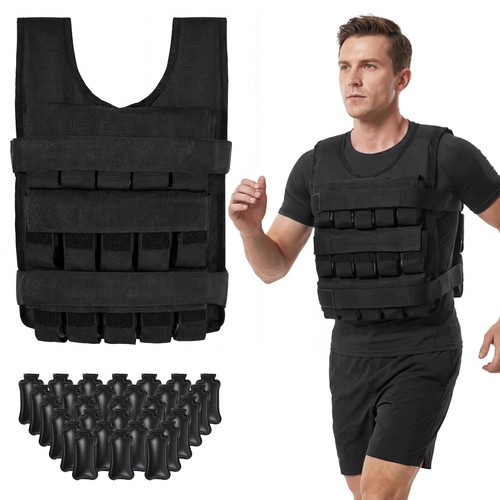
VEVOR 4-10 lb Adjustable X-Shape Weighted Vest
- Weight
- 4 to 10 lb
- How
- Adjustable: 6 removable 1 lb (0.45 kg) packs
from$29.902 stores
Home gym tools
Three published sources give their vest weight guidance as a share of body weight. Enter yours to see those figures worked out, then compare the vests we list.
UCLA Health says to start at about 5% of body weight, Cleveland Clinic gives 5 to 10%, and Harvard Health says not to exceed 10%.
Each figure is quoted word for word below with a link to its source. Compare the weighted vests we list, or read our weighted vest buying guide.
UCLA Health
About 5%
of body weight
"The general recommendation is to start with a vest that's about 5% of your body weight."Read it at UCLA Health
Cleveland Clinic
5 to 10%
of body weight
"Research shows it's best to choose a vest that is 5 to 10% of your body weight."Read it at Cleveland Clinic
Harvard Health
Up to 10%
of body weight
"Experts suggest using weighted vests that don't exceed 10% of your body weight."Read it at Harvard Health
The lowest and highest cited figures, worked out in lb. Cleveland Clinic's 5 to 10% runs between the two columns. The 10% column rounds down, so it never shows more than the source allows.
| Body weight | 5% (UCLA Health) | 10% (Harvard Health) |
|---|---|---|
| 120 lb | 6 lb | 12 lb |
| 140 lb | 7 lb | 14 lb |
| 160 lb | 8 lb | 16 lb |
| 180 lb | 9 lb | 18 lb |
| 200 lb | 10 lb | 20 lb |
| 220 lb | 11 lb | 22 lb |
| 240 lb | 12 lb | 24 lb |
| 260 lb | 13 lb | 26 lb |
| 280 lb | 14 lb | 28 lb |
Each vest's range comes from its maker's listed specs. Enter your weight above to check them.


VEVOR


Fringe Sport


VEVOR

Fringe Sport


Costway

Costway

BalanceFrom

Titan Fitness
Costway
The UCLA Health article is about walking with a weighted vest. Under the heading "How heavy should a weighted vest be for walking?" it says: "The general recommendation is to start with a vest that's about 5% of your body weight." It adds: "Another strategy is to keep the weight the same but increase the distance or intensity of your walk."
UCLA Health gives a starting point rather than a range: "The general recommendation is to start with a vest that's about 5% of your body weight." and "As you gain fitness, strength and endurance, you can gradually increase the amount of weight." Harvard Health's figure is a ceiling: "Experts suggest using weighted vests that don't exceed 10% of your body weight."
UCLA Health: "That's why Dr. Hame likes vests that come with adjustable weights. 'You can slowly build up in small increments,' she suggests."
Of the 11 vests we list in the US, 6 adjust with removable weights, 4 are single weights and 1 has no adjustment listed by its maker. Compare them all.
UCLA Health: "The general recommendation is to start with a vest that's about 5% of your body weight." Cleveland Clinic: "Research shows it's best to choose a vest that is 5 to 10% of your body weight." Harvard Health: "Experts suggest using weighted vests that don't exceed 10% of your body weight."
UCLA Health: "The general recommendation is to start with a vest that's about 5% of your body weight. As you gain fitness, strength and endurance, you can gradually increase the amount of weight."
UCLA Health: "As you gain fitness, strength and endurance, you can gradually increase the amount of weight. That's why Dr. Hame likes vests that come with adjustable weights. 'You can slowly build up in small increments,' she suggests."
These figures are the published percentages applied to the weight you enter, and vest weights are the makers' listed specs. They are not advice for you: follow the advice of your doctor or a physical therapist who knows your health.
We do not set a vest weight ourselves. Each figure above is one source's published guidance, given as a share of body weight, and the quotes are word for word. The tool multiplies your body weight by each percentage and rounds to one decimal place in kilograms or to the nearest half pound, using the international pound. Where a source gives a ceiling or the top of a range, we round down, so the figure shown is never above the one the source gives.
The band runs from the lowest figure any source gives (5%) to the highest (10%). A vest counts as inside it when its listed weight range overlaps the band. Ranges are the makers' own specs, and an overlap does not mean every weight in it can be set: adjustable vests move in the steps their makers list, and where a maker does not say how a vest adjusts we say so. Where a maker lists no lightest setting we do not assume one. A vest sold in set weights is one weight per purchase, so we list which of its set weights fall inside the band, and it never counts as spanning it. Specs are stored in kilograms rounded to one decimal place, so we allow for that rounding at each edge. Prices are the lowest the retailers listed when we last checked.
These sources are written for a general audience and are not a plan for you. Harvard Health says not to wear a vest if movements are difficult or you feel pain or soreness after wearing it.