
Home gym tools
Gym flooring calculator: how many tiles do you need?
Enter your floor and a tile or mat size or one of the 2 we list in Canada to see how many pieces to buy with the spare allowance you choose, how many are cut at the edges, and how thick published guidance says the floor should be for how you train.
You need
28 tiles
2 packs of 25, 22 left over
Estimate: a straight grid from one corner. See how this works
- Laid
- 25 (5 x 5)
- Cut at the edges
- 9
- Spare (10 %)
- 3
- Floor area
- 7.5 m²
- Floor rises by
- 14.2 mm
- Weight to carry
- about 68 lb
By area alone the floor is 21 tiles' worth; the rest is offcut from the edge pieces.
Buy 2 packs of VEVOR 0.56 in Interlocking Gym Floor Mats, 25 Tiles (HRD-XJD6614-25W)
2 x listed price: $511.80at VEVOR (official store 2) on eBay Canada, checked 2026-11-27
Thickness for general fitness training
10 mm
"10 mm (roughly 0.39") should be plenty for general fitness training."
At or above VEVOR 0.56 in Interlocking Gym Floor Mats, 25 Tiles (HRD-XJD6614-25W) is 14.2 mm.
Gym flooring we list in Canada, worked out for your floor
Sizes and thicknesses are as each maker lists them, each linked to its source. Ordered by the listed price of the packs your floor takes.
Not sure which flooring? See our guide to the best home gym flooring or the best gym mats and exercise mats.

VEVOR · Interlocking tiles
VEVOR 0.56 in Interlocking Gym Floor Mats, 25 Tiles (HRD-XJD6614-25W)
- Tile
- 61 cm square
- Per pack
- 25
- Thickness
- 14.2 mm
- Material
- Rubber top layer on EVA foam
size source (read 2026-11-15)
Your floor: 28 tiles, 2 packs · about 68 lb in all
At or above the quoted figure10 mm for general fitness training
from$255.902 x listed price: $511.80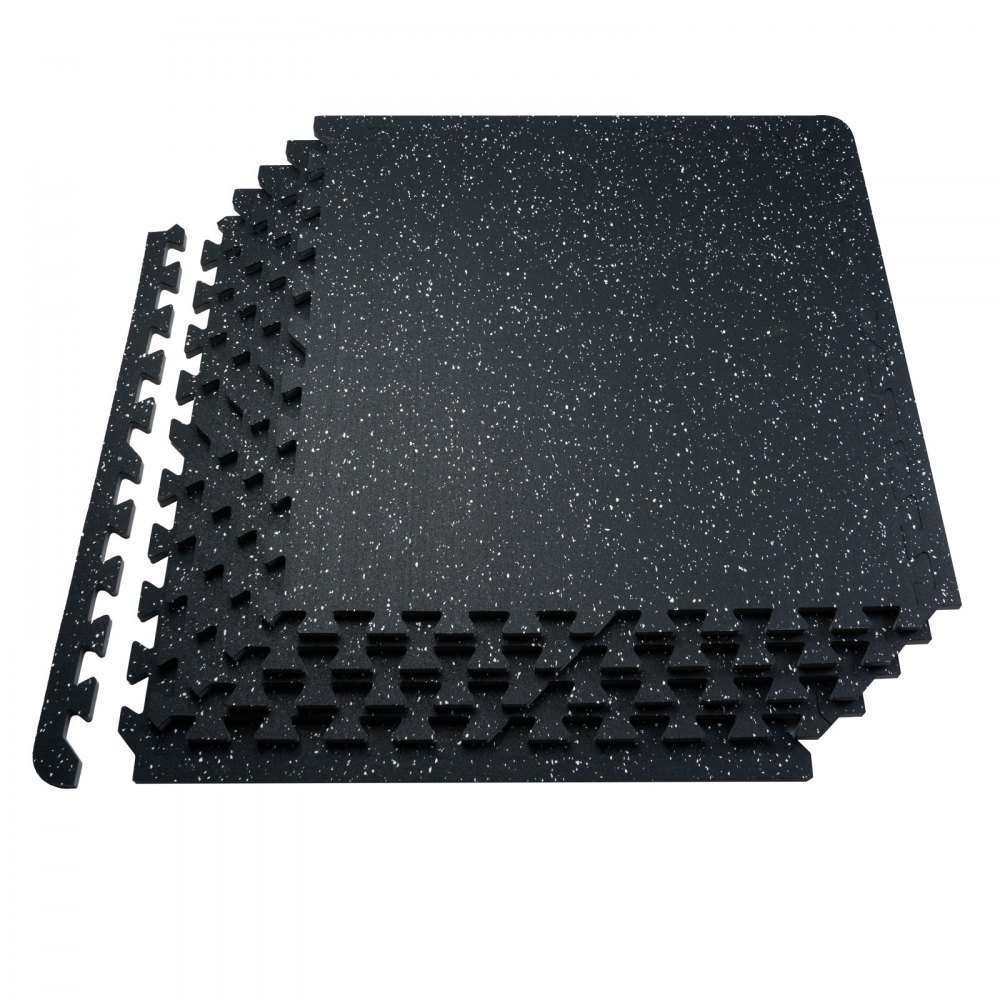
VEVOR · Interlocking tiles
VEVOR 0.56 in Interlocking Gym Floor Mats, 12 Tiles (HRD-XJD6614-12W)
- Tile
- 61 cm square
- Per pack
- 12
- Thickness
- 14.2 mm
- Material
- Rubber top layer on EVA foam
size source (read 2026-11-15)
Your floor: 28 tiles, 3 packs · about 68 lb in all
At or above the quoted figure10 mm for general fitness training
How thick should gym flooring be?
No standard sets it. As one guide puts it: "There's no real industry standard for what's good or bad, but we've noticed that gym flooring is mostly commonly sold in 8-mm rolls, which is roughly 0.31 inches." These are the figures that guide gives for each kind of training, quoted as written.
| Training | Figure given | In their words |
|---|---|---|
| Bodyweight, yoga and stretching | None | "In that case, you should choose what's comfortable; you probably don't need to worry about heavy-duty rubber flooring." (Garage Gym Reviews) |
| General fitness training | 10 mm (0.39 in) | "10 mm (roughly 0.39") should be plenty for general fitness training." (Garage Gym Reviews) |
| Heavy lifting or dropping weights from overhead | 12.7 mm (0.5 in) | "If you're planning on heavy lifting, or dropping weight from overhead, I'd recommend a half-inch-thick rubber mat, at the minimum. That said, I typically prefer 3/4-inch flooring." (Caine Wilkes, Olympic weightlifter, quoted by Garage Gym Reviews) |
| Deadlifts | 19.1 mm (0.75 in) | "We recommend choosing the thickest flooring you can afford, aiming for [at] least 0.75 inches in thickness." (Garage Gym Reviews) |
On foam for lifting, the same guide says: "Foam mats aren't meant to withstand heavy loads, however, so we don't recommend them for strength training purposes; only bodyweight exercises." Its figures are for rubber, and they are one publisher's guidance, not ours.
Horse stall mats for a home gym
On the size horse stall mats come in, the same guide says: "They're often sold in 4-foot-by-6-foot squares, though other sizes can be found." (Garage Gym Reviews). Load that size to see how many your floor takes, then check the size of the mats you buy.
Counts are estimates from the floor you enter and the sizes makers list. Thickness figures are guidance quoted from the source named, not a standard and not our recommendation. Check the maker's own sizes before you buy.
How this works
What it works out
- Pieces laid: the floor's length over the piece's length, rounded up, times its width over the piece's width, rounded up. That is a straight grid from one corner with the last row and column cut to fit. For an oblong mat the tool tries it both ways round and keeps the one that takes fewer pieces.
- Cut pieces: the pieces laid minus the ones that fit whole. If you can use one offcut for two edge gaps, you may need fewer; the "by area alone" figure is the least any layout could take.
- Spare allowance: your percentage of the pieces laid, rounded up, added on top. It is an input with our starting figure, since no standard sets one.
- Packs: the pieces to buy over the pieces in a pack, rounded up, using the pack count the maker lists. A total is the store's listed price for one pack times the packs, at the date we last checked it; prices change, so check the store.
- Thickness: the listed thickness set beside the figure the source below gives for the training you pick. "At or above" and "thinner" compare two numbers; neither is a verdict on your floor. The floor rise adds any layer you put underneath, which matters at doors.
- Rounded sizes: makers round their sizes, so a run of tiles can come out a hair off a whole number (an 8 ft run of 24 in tiles listed as 61 cm works out at 3.997 tiles). The tool takes a count within a quarter of a percent of a whole number as that number of whole pieces.
How to measure
- Measure the floor wall to wall at more than one point and use the longest. Rooms are rarely square.
- For a lifting area or a patch under a rack, measure the patch you want covered, not the room.
- For an L-shaped room, work out each rectangle on its own and add the results.
- Check door swing: the floor rise figure is how much higher the floor will be.
Sources
- Sizes, pack counts, thicknesses, materials and weights: each maker's listing, stored with a receipt on our product record. Every product above links to the page its size came from.
- Thickness guidance, the quote on foam and the horse stall mat size: Garage Gym Reviews, "How Thick Should Gym Flooring Be, According to Home Gym Experts" (updated January 27, 2026) (read 2026-11-15). The heavy lifting figure is quoted there from Caine Wilkes, an Olympic weightlifter.
- Inches, feet and centimetres: one inch is 2.54 centimetres and one foot is 12 inches, from NIST Guide to the SI, Appendix B.8.
- Prices are the stores' listed prices when we last checked them, shown only beside a live offer.